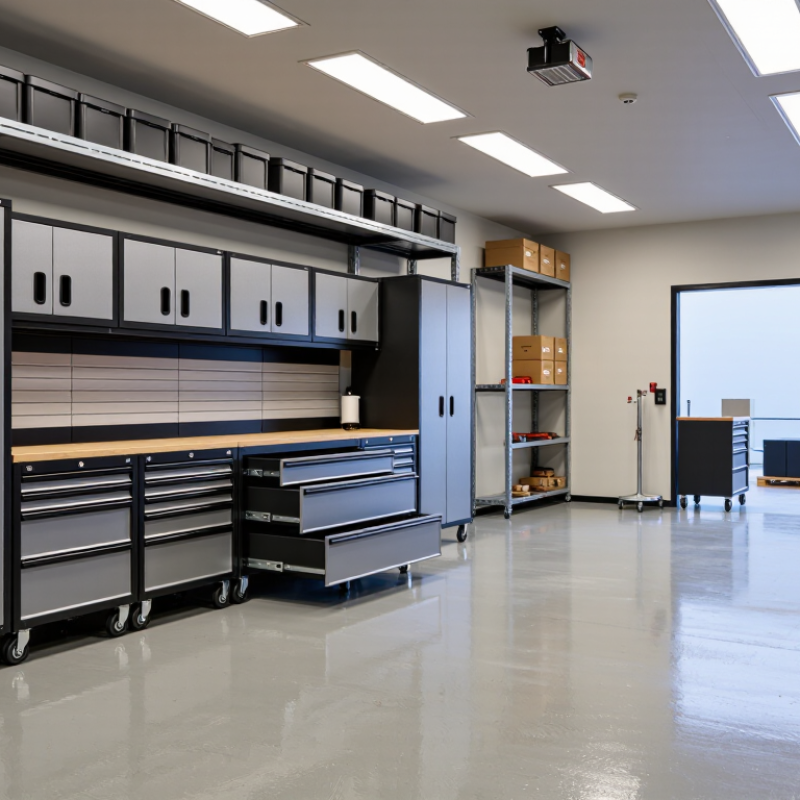
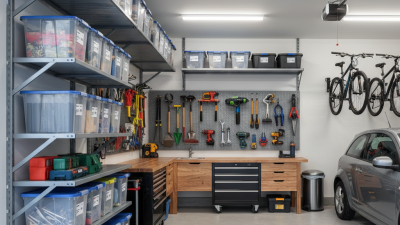
Choosing a China garage storage manufacturer is not simply a matter of finding the lowest quotation. A reliable partner should combine product quality, engineering experience, production control, and responsive communication. In practice, a cabinet that looks strong online may wobble after installation or rust near a damp garage door. This guide explores how buyers can compare manufacturers before placing a serious order. Garage Storage should be treated as a long-term working system, not a collection of attractive boxes.
The discussion will examine steel gauge, welding consistency, powder-coating performance, drawer slide quality, load ratings, and modular compatibility. It will also consider factory capability, sample approval, quality inspections, packaging, delivery records, and after-sales support. Buyers should request measurable specifications instead of accepting phrases such as “premium quality.” Photographs help, but hands-on samples reveal sharp edges, uneven gaps, weak hinges, and difficult assembly. A factory visit or independent inspection can provide stronger evidence than a polished catalog. Still, every verification method has limits.
A trustworthy manufacturer should answer technical questions clearly and provide documents matching the actual product. Certifications may support confidence, but buyers should check their scope, validity, and issuing organization. Price matters, yet a low bid can hide thinner steel, reduced accessories, or fragile packaging. This guide will compare these trade-offs from a practical buyer’s perspective, including custom colors, space planning, replacement parts, and warranty terms. No supplier is perfect. Good decisions come from evidence, careful questions, and a willingness to reconsider attractive promises.
China’s garage storage manufacturing industry has developed around practical steel fabrication, modular design, and export-focused production. Many factories produce cabinets, workbenches, pegboards, shelving, and mobile storage units under one roof. This concentration can shorten lead times and reduce tooling costs. However, capacity alone does not prove reliability.
A professional buyer should examine material thickness, weld consistency, coating adhesion, and drawer load performance. Ask for test records, production samples, and clear tolerance standards. In a humid coastal warehouse, weak powder coating may develop rust around hinges and screw holes.
Packaging also matters. Protective corners, foam layers, and moisture barriers can prevent damage during long-distance shipping. Factory audits should review incoming materials, assembly lines, inspection records, and worker training.
Experience often reveals small problems early. A drawer that feels smooth when empty may jam under weight. A shelf may bend after repeated use. No audit is perfect. A polished sample can hide production variation. Buyers should request random inspections during manufacturing, not only before shipment. They should also confirm spare-part availability, installation instructions, and response times for quality claims. Chinese manufacturers can offer strong customization, but unclear drawings create expensive misunderstandings. Precise dimensions, finish requirements, carton markings, and acceptance criteria make cooperation more dependable.
Garage storage products should match the work happening in the space. Wall-mounted cabinets protect tools from dust and moisture. Pegboards and slatwall panels keep frequently used items visible. Freestanding shelves suit plastic bins, paint containers, and seasonal equipment. Overhead racks use ceiling space for ladders or rarely used luggage. A 2024 Grand View Research report valued the global self-storage market at about USD 58.26 billion in 2023. This growth reflects stronger demand for compact, organized storage, although self-storage data does not directly measure household garage products.
Tips: Check load ratings, steel thickness, coating quality, and installation requirements. Leave walking space around vehicles. Place heavy bins below waist height. Confirm ceiling joist spacing before buying an overhead rack. Small details matter.
When comparing China-based garage storage manufacturers, review product testing, welding consistency, packaging protection, and replacement-part support. Cabinets need smooth hinges and adjustable shelves. Racks need stable feet and clear weight labels. A professional supplier should provide drawings, load calculations, installation instructions, and inspection records. The International Organization for Standardization notes that documented quality processes improve consistency, but paperwork alone proves little. Request samples and test them with real tools. A rack that holds 300 kilograms on paper may perform differently on an uneven garage floor. I have seen attractive layouts fail because doors opened into parked vehicles. Storage planning is not perfect. Measure twice, and question impressive specifications.
Evaluating Chinese garage storage manufacturers requires more than comparing catalog prices. Start with production evidence. Ask for factory photos, material specifications, and recent quality records. A reliable manufacturer should explain its steel thickness, coating process, weld inspection, and load-testing method clearly. Vague answers deserve caution.
Request a physical sample before placing a large order. Check whether drawers slide smoothly and whether cabinet doors stay aligned. Examine sharp edges, uneven powder coating, weak hinges, and loose fasteners. Test the unit with realistic tools, not just empty shelves. This practical check often reveals problems that polished product images hide. It may also expose your own poor assumptions.
Communication matters during evaluation. Confirm drawings, dimensions, packaging details, replacement parts, and delivery responsibilities in writing. Ask how the factory handles damaged panels or inconsistent colors. A professional supplier should provide inspection reports and explain corrective actions without defensiveness. Relevant certifications can support confidence, but certificates should match the actual product and current factory site. Do not treat paperwork as proof of everything.
Visit the facility when possible, or use an independent inspection service. Observe storage conditions, worker procedures, and final assembly. A clean showroom proves little. Capacity must match your order volume. Very low pricing may reflect thinner steel, weaker packaging, or limited after-sales support. I have found that rushed decisions create expensive revisions later. Leave room for questions, testing, and uncomfortable findings.
Choosing a top garage storage manufacturer requires more than a polished catalog. Grand View Research estimates the global garage storage market reached about USD 1.8 billion in 2023, with growth continuing through 2030. This expansion attracts new factories, but scale does not prove durability. Ask for load-test records, weld inspection reports, coating specifications, and corrosion testing. In my sourcing experience, a drawer that feels smooth on day one can loosen under dust, moisture, and uneven floors. Request physical samples before approving full production. Shortcuts appear quickly.
Quality must be compared through measurable specifications. Check shelf capacity, steel thickness, hardware grade, and assembly tolerance. Ask which test methods support each claim. Customization may include cabinet dimensions, hole patterns, colors, handles, packaging, and CAD adjustments. More options usually mean higher tooling costs and larger minimum orders. A factory that says “anything is possible” may simply be avoiding a clear answer.
Pricing should reflect landed cost, not factory price alone. Include tooling, packaging, inspection, freight, spare parts, and possible rework. MHI’s 2024 Annual Industry Report surveyed more than 1,000 supply-chain and manufacturing leaders, highlighting continuing pressure on capacity and resilience. Ask for monthly output, current utilization, lead times, and backup production lines. High capacity can reduce delays, yet it may also reduce attention to small custom orders. I would not choose the cheapest quote. I would compare evidence, then question my assumptions.
| Evaluation Dimension | Realistic Industry Benchmark | What to Check with the Manufacturer | How It Affects Purchasing Decisions |
|---|---|---|---|
| Material Quality | Cold-rolled steel is commonly used for cabinets, wall panels, and workshop storage systems. A powder-coated finish is widely preferred for corrosion and abrasion resistance. | Confirm steel grade, sheet thickness, surface-treatment process, coating type, and whether salt-spray or coating-adhesion test records are available. | Thicker steel and better coating systems generally increase durability and price. Material specifications should be compared rather than relying only on product appearance. |
| Load Capacity | Typical cabinet shelves are often engineered for approximately 50–150 kg per shelf, depending on dimensions, reinforcement, and load distribution. | Request tested shelf capacity, cabinet base capacity, drawer capacity, test conditions, and whether the stated load is evenly distributed or point-loaded. | A higher rated load is valuable for tools, machinery parts, and bulk storage, but excessive capacity may add material cost without improving a light-duty application. |
| Product Safety | Tall cabinets should include anti-tip measures, secure door hardware, stable leveling feet, and suitable anchoring provisions where required. | Check anti-tip interlocks, wall-anchoring holes, lock quality, door alignment, edge treatment, and packaging protection for corners and panels. | Safety features reduce installation and warranty risks, particularly in garages, workshops, warehouses, and commercial maintenance areas. |
| Customization | Common options include cabinet width and height, drawer layouts, shelf spacing, worktops, pegboards, casters, locks, colors, logos, and modular combinations. | Ask for CAD or 3D drawings, tolerance limits, minimum order quantities, tooling charges, sample approval procedures, and engineering revision control. | Customization improves space utilization but normally increases engineering time, sampling cost, and minimum order requirements. |
| Dimensional Accuracy | Consistent panel dimensions, hole spacing, drawer alignment, and door gaps are essential for modular systems and multi-unit installations. | Review inspection standards, measuring tools, first-article inspection records, assembly fit checks, and dimensional tolerances shown on technical drawings. | Better dimensional control lowers installation labor and prevents mismatched modules in large projects. |
| Surface Finish | Powder coating is a common finish for steel garage storage because it provides a uniform decorative surface without the solvent emissions associated with conventional liquid coatings. | Confirm pretreatment steps, powder type, coating thickness target, color reference, adhesion testing, impact resistance, and protection against scratches during shipping. | A stable finish improves appearance and service life. Color matching and special textures may require additional setup or minimum quantities. |
| Quality Management | A documented quality system based on ISO 9001 principles can help standardize purchasing, production, inspection, corrective action, and traceability. | Verify the certificate scope and validity, incoming-material inspection, in-process checks, final inspection records, nonconformance procedures, and batch traceability. | A formal quality system does not replace product testing, but it can reduce variation and improve consistency across repeat orders. |
| Production Equipment | Efficient sheet-metal production commonly uses laser cutting, CNC punching, press-brake forming, welding, grinding, powder coating, and final assembly. | Determine which operations are performed in-house, equipment capacity, preventive-maintenance records, automation level, and dependence on outside subcontractors. | In-house control may improve lead-time stability and engineering responsiveness, while specialized outsourcing can be acceptable when properly managed. |
| Production Capacity | Capacity should be measured by defined products or production hours rather than a general claim such as “large capacity.” | Request monthly capacity by product family, current utilization, peak-season availability, number of shifts, bottleneck processes, and recent on-time-delivery performance. | A factory with suitable spare capacity is generally better positioned for repeat orders, seasonal demand, and urgent replenishment. |
| Lead Time | Lead time normally varies with product complexity, customization, sampling, raw-material availability, order quantity, and production scheduling. | Separate sample lead time, mass-production lead time, packaging time, inspection time, and transit time. Confirm the definition of the promised shipment date. | A low unit price may not be advantageous if long or unstable lead times create stockouts, project delays, or higher inventory costs. |
| Pricing Structure | The total landed cost includes product price, tooling or sampling fees, packaging, inland transport, export documentation, freight, insurance, duties, and local delivery. | Compare quotations using the same specifications, Incoterm, quantity, packaging standard, payment terms, warranty scope, and inspection requirements. | The lowest quotation is not necessarily the lowest total cost. A transparent cost breakdown makes supplier comparisons more reliable. |
| Packaging and Shipping | Common protection methods include corrugated cartons, foam or molded corner protection, stretch film, pallets, and moisture-resistant export packaging where appropriate. | Check drop-risk protection, carton strength, pallet dimensions, container utilization, package markings, stacking limits, and replacement policy for transit damage. | Efficient packaging can reduce damage and freight cost, but insufficient protection may create losses that exceed the initial price saving. |
| Order Flexibility | Flexible suppliers may support mixed models, staged shipments, small trial orders, replacement parts, and repeat production using approved specifications. | Confirm minimum order quantity, mixed-container policy, replenishment terms, spare-part availability, change-control procedure, and sample retention policy. | Flexibility is especially important for distributors testing a market or managing multiple garage-storage configurations. |
| After-Sales Support | Professional support commonly includes assembly instructions, installation drawings, spare parts, defect reporting, corrective action, and defined warranty terms. | Review warranty duration and exclusions, response time, evidence requirements, replacement-part availability, and responsibility for confirmed manufacturing defects. | Clear after-sales procedures reduce downtime and protect the buyer from uncertain claims handling after delivery. |
| Recommended Selection Method | Best Practice Use a weighted supplier scorecard instead of comparing unit price alone. | Suggested weighting: quality and safety 30%, customization and engineering 20%, price and landed cost 20%, production capacity and lead time 15%, service and compliance 15%. | The weighting should reflect the project. Heavy-duty commercial installations may prioritize load performance and reliability, while retail programs may emphasize packaging, appearance, and cost. |

Selecting a China garage storage manufacturer should begin with evidence, not catalog images. Grand View Research valued the global home organization products market at about USD 12.5 billion in 2023, showing strong demand but also intense supplier competition.
Build a shortlist of three to five factories. Check their years of production, export markets, monthly capacity, and material sources. Ask for business licenses, quality certificates, factory videos, and recent inspection records.
Request a sample cabinet, rack, or wall panel before discussing large orders. Measure steel thickness with a micrometer. Test drawer movement repeatedly. Inspect welds, powder coating, hinges, and packaging corners.
A TÜV Rheinland industry report notes that product testing and traceability remain important controls in furniture supply chains.
Your supplier should provide load tests, coating specifications, assembly instructions, and replacement-part procedures. Small details matter.
Ask for a written quotation with tooling, packaging, shipping terms, warranty coverage, and defect limits. The International Trade Centre reports that transport costs and trade procedures can materially affect landed prices, so compare total cost rather than factory price.
Confirm production lead time with a pilot order. Do not trust every impressive showroom. I have seen polished samples hide weak cartons and inconsistent drilling. That mistake is expensive.
Use an independent pre-shipment inspection, and keep approval samples sealed for future comparison. Production can change quietly. Your contract should not.