
A Kitchen Table is more than a surface for meals. It must fit the room, withstand daily use, and arrive in good condition. For global buyers, the decision also involves dimensions, materials, finish, packaging, and delivery terms. A table that looks perfect online may feel oversized beside a narrow doorway. Small details matter.
The design principle of British designer and craftsman William Morris offers a useful lens: “Have nothing in your houses that you do not know to be useful, or believe to be beautiful.” For a Kitchen Table, both tests count. Ask how many people it seats comfortably, whether its legs leave enough knee space, and how its finish may respond to spills or heat. Check the listed measurements against your room and entry route. Measure twice.
These seven buying tips will help compare table shapes, materials, construction, finishes, supplier details, and shipping considerations. Look for clear specifications and close-up product images, then ask sellers about details that remain unclear. A solid-wood top, for example, may show natural variation; that can be appealing, but it may not match a perfectly uniform expectation. No checklist removes every uncertainty. I would still pause over vague descriptions or missing measurements. Careful questions can reveal what a polished product photo cannot, helping buyers choose a table suited to their home, budget, and everyday routines.
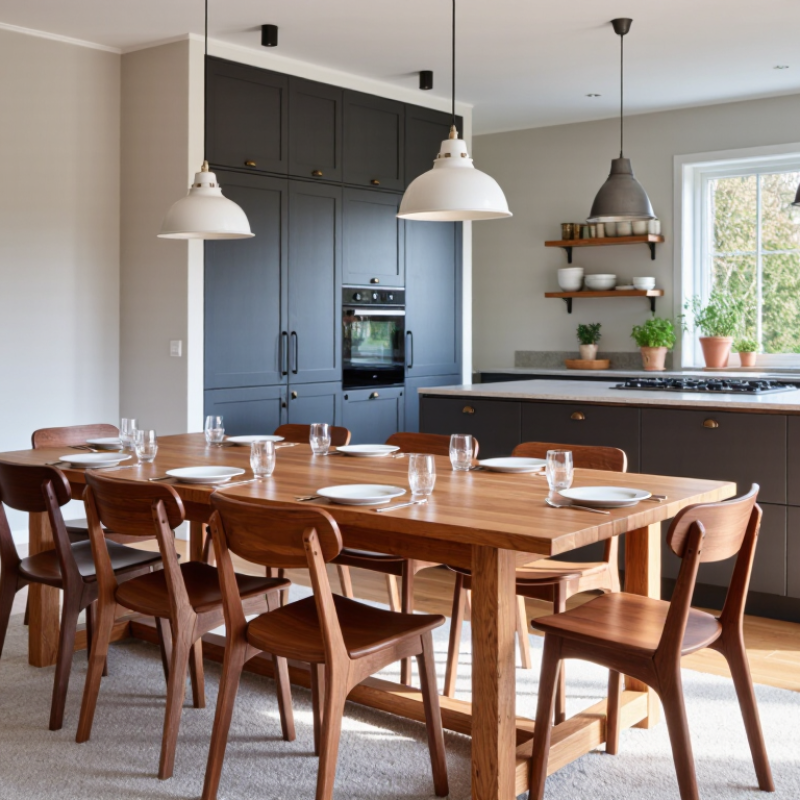
When comparing kitchen tables, allow about 24 inches (61 cm) of table edge for each seated person. This gives most adults enough room for a plate, cutlery, and comfortable elbow space. A 48-inch (122 cm) edge can usually seat two people comfortably. A 72-inch (183 cm) edge can often fit three, though chair width and table legs affect the result. Check the usable edge, not just the table’s overall length.
Shape matters. A rectangular table offers clear seating positions along its sides, while a round table spreads diners around its perimeter. For a round design, divide the circumference by 24 inches to estimate capacity; treat that number as a guide, not a guarantee. Chairs with wide arms need more space. So do diners who prefer generous elbow room. Measure your chairs, then mark the proposed table outline on the floor with painter’s tape. Sit around it. It may feel different than expected.
Leave room to pull chairs back and walk behind them. In a compact kitchen, a table that technically seats six can still make daily movement awkward. I have seen people focus on the seat count and overlook the doorway. That is an easy mistake. Recheck the layout with the refrigerator and cabinets open, too. A little extra edge space can feel luxurious, but it may cost valuable floor area.
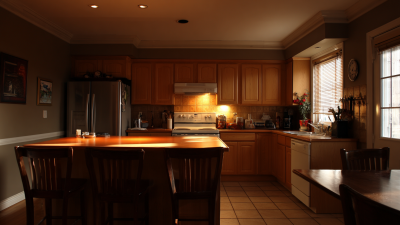
Choose a dining table height that works with the chairs people will actually use. Most dining tables measure 28–30 inches (71–76 cm), a common furniture-industry range rather than a universal fit. A 30-inch table can feel awkward if the seat is unusually high or the tabletop has a deep apron. Check the clearance beneath it, too. About 10–12 inches between the chair seat and table underside usually allows room for knees, but test with the intended chair when possible.
Body size varies across markets. The U.S. National Center for Health Statistics reported average adult heights of 175.4 cm for men and 161.7 cm for women, based on 2015–2018 measurements. Those figures do not define a global standard; they show why one fixed height may not suit every household. EN 12521:2015 addresses domestic table safety, strength, and durability, not a single comfortable height. Sit at a sample table for several minutes. Check whether forearms rest naturally and feet feel supported. A small detail, but noticeable. If buyers cannot test in person, request the tabletop-to-apron clearance and pair it with the chair’s seat height. Dimensions can look right on paper and still feel wrong.
When comparing kitchen tables, ask whether the exact model was assessed against EN 12521:2015, which sets safety, strength, and durability requirements for domestic tables. EN 1730 describes test methods used to assess stability, strength, and durability. These references are more useful than a vague “tested” claim. Ask for a dated report identifying the table, materials, dimensions, and test setup. Check that the tested version matches the one you plan to buy, including its leg design and extension leaves. Small changes can matter.
Read the findings, not just the standard numbers. A clear report should show what was tested and whether issues arose, such as movement under load or loosened joints. Ask how the table performed after repeated use, and whether assembly instructions were included in the assessment. For global purchasing, confirm the report’s scope with your importer or local compliance adviser; a test report is not automatically approval in every market. It can still leave questions. I would also inspect a sample in person: press gently on a corner, check for wobble, and look beneath the top for secure fixings. Tests offer evidence, but they cannot replace careful product matching and inspection.
Check Strength and Safety Against EN 12521:2015 and EN 1730 Test Methods
The bars show the number of practical checklist questions included for each tip; they are not test results or product ratings. EN 12521:2015 specifies safety, strength and durability requirements for domestic tables, while EN 1730 sets out test methods for assessing table stability, strength and durability. Ask suppliers for relevant test documentation and confirm that the product and intended use are within the scope of the standards.
Before ordering a kitchen table, ask the supplier to identify the wood by species, not just by a broad label such as “hardwood.” Oak, ash, and rubberwood differ in grain, weight, and moisture response. Ask whether the identification is based on supplier records or independent verification. Ask for evidence.
The wood’s origin should be specific enough to check. A country name is useful, but a region or mill location can make the answer clearer. Request documents linking the timber to the table, such as purchase records, packing lists, and a traceability statement. Details should match across documents. If names, dates, or quantities conflict, pause and ask for clarification before payment.
Traceability is not a guarantee of quality. It helps you understand where the material came from and how it moved through the supply chain. For a large order, request photos of the production batch, wood labels, and finished-table markings. Keep the records with your order file, especially when import paperwork is required. A supplier may not be able to disclose every upstream detail, and that can be frustrating. Still, a clear explanation is more useful than a polished claim with no supporting records. Ask what the documents do—and do not—confirm.
| Tip | Buying Check | What to Verify | Evidence to Request | Potential Red Flags |
|---|---|---|---|---|
| 1 | Confirm the wood species | Ask for the common name and botanical name for every solid-wood component. Common examples include oak (Quercus spp.), beech (Fagus spp.), and rubberwood (Hevea brasiliensis). Veneer, engineered panels, and solid wood should be identified separately. | A written materials specification, product construction details, and clear photographs of the tabletop edge and underside. | Descriptions such as “premium hardwood” with no species details, or a sample that appears inconsistent with the written specification. |
| 2 | Check the declared harvest origin | Ask where the timber was harvested, not only where the table was manufactured or shipped from. Origin may vary by species, supplier, and production batch. | A species-and-origin declaration linked to the product or batch, supported where available by supplier records and shipping or purchase documentation. | A country-of-manufacture statement presented as proof of timber harvest origin, or answers that change between documents. |
| 3 | Map the supply chain | Trace the wood through the relevant stages, such as forest or harvesting area, sawmill, processor, and furniture factory. Ask how the supplier keeps records connected to the order. | A dated chain-of-custody summary, batch or lot references, and records showing how incoming timber is linked to finished products. | Generic statements about responsible sourcing without records identifying the material used for the specific order. |
| 4 | Review certification claims carefully | If a supplier claims FSC or PEFC certification, confirm the certificate is current and that its scope covers the relevant operation and product claim. Certification does not replace checking the order documents. | The certificate code and scope, plus sales or transaction documentation where applicable to the claim and product. | A logo or certificate image alone, an expired certificate, or a claim that does not match the product or supplier scope. |
| 5 | Check legality and import requirements | Identify the destination market’s applicable timber legality, customs, and documentation requirements. Requirements differ by jurisdiction, species, and shipment; confirm them before production or shipment. | Species and origin details, supplier declarations, and any permits or due-diligence records required for the destination market. | Assurances that one general certificate automatically satisfies every country’s import rules. |
| 6 | Specify construction and moisture controls | Confirm which parts are solid wood, veneer, plywood, or particleboard, and ask how timber is dried and checked. Suitable moisture content depends on the wood, product, and destination climate. | A construction and materials schedule, the supplier’s moisture-control specification, and inspection results for the production batch when available. | Unspecified mixed materials, no explanation of panel construction, or a single moisture figure presented as suitable for every climate and product. |
| 7 | Match samples and records to the order | Before approval, compare the sample, finish, dimensions, and material schedule with the purchase order. Require advance notice and approval for any species, origin, or construction change. | A signed or otherwise documented pre-production approval, final specification, inspection checklist, and batch-level documents before shipment. | Substitutions made without written approval, or final paperwork that does not identify the shipped product or batch. |
A 20-ft container offers roughly 33 m³ of internal space, while a 40-ft container offers about 67 m³. Treat these as planning estimates, not guaranteed loading capacity. Door openings, container condition, and carton shape affect what fits. Kitchen tables can be deceptively bulky, especially when legs remain attached or protective packaging adds width. Measure each packed carton, not just the assembled table. Multiply length, width, and height in metres to find its cubic volume.
Keep it practical. A carton measuring 1.2 × 0.8 × 0.2 metres uses about 0.19 m³. Divide the container’s estimated space by the carton volume for a rough upper limit, then allow room for safe loading. Real loads rarely fit like perfect blocks. Cartons may need gaps, and fragile corners should not bear heavy pressure.
Confirm the container’s internal dimensions and door clearance with your freight provider before booking. Weight limits matter too, though table shipments often run out of space first. I have seen neat estimates fall short because one oversized tabletop changed the loading pattern. Leave a buffer. The exact allowance depends on packaging and how the shipment is loaded.