2026 Best Wholesale Clothing Racks for Retailers?
Choosing the right Clothing Racks can shape how customers browse, how staff replenish stock, and how much floor space remains usable. In 2026, retailers face a wide range of options, from lightweight rolling rails to heavy-duty, wall-mounted systems. The best choice depends on the merchandise, store layout, and daily handling—not simply the lowest price.
Retail anthropologist Paco Underhill is often associated with the phrase, “Retail is detail.” It is a useful reminder when comparing fixtures. A rail that looks sturdy online may wobble under dense denim. A beautiful rack may block a fitting-room path. Check load capacity, finish, wheel locks, height adjustment, and assembly requirements before ordering. Small details matter.
This guide explores wholesale Clothing Racks for boutiques, department stores, pop-ups, and growing retailers. It considers materials, rack styles, bulk pricing, supplier questions, and practical ways to assess durability. Product specifications are helpful, but they do not replace testing a sample in your own space. Measure the aisle. Hang your heaviest items. Roll the rack across the actual floor. No fixture suits every store, and even a well-reviewed model may disappoint when its dimensions or capacity are wrong for your inventory. A little caution is worthwhile.
2026 Rack Types: Rolling, Double-Rail, and Wall-Mounted Systems
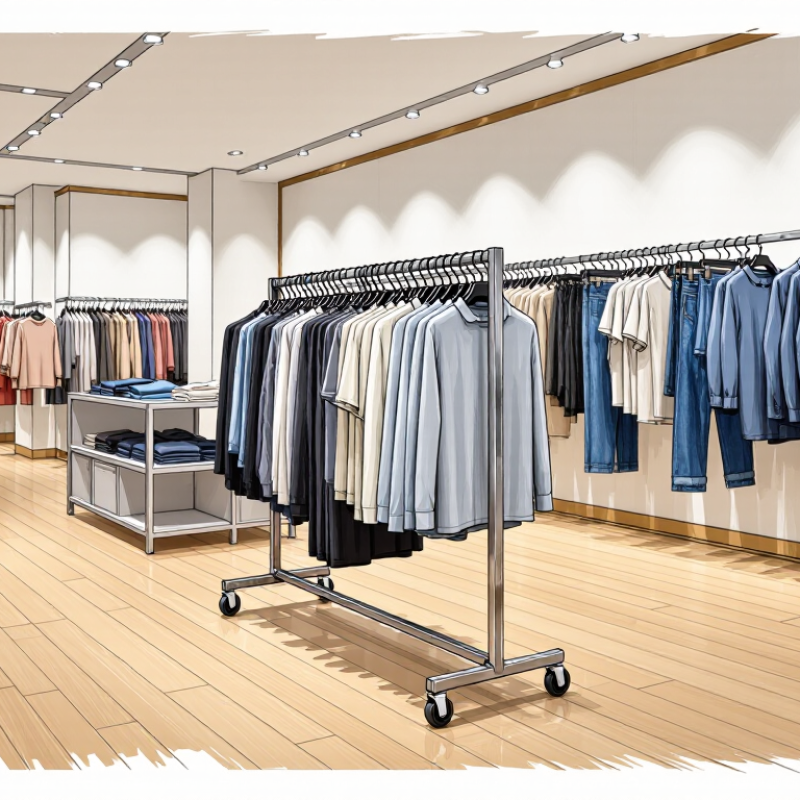
For 2026, choose clothing racks around the way shoppers move through your store. Rolling racks suit seasonal displays and quick floor resets; lockable casters help prevent unwanted movement. Double-rail systems use vertical space for separates or coordinated outfits, but crowded lower bars can make browsing awkward. Wall-mounted rails keep narrow aisles clear and create a neat perimeter display. They are less flexible, so measure carefully before fixing them in place.
The U.S. Census Bureau reported that e-commerce accounted for 16.1% of total U.S. retail sales in the fourth quarter of 2024. Physical stores still need displays that make products easy to touch, compare, and discover. For wholesale purchasing, compare load capacity, finish, rail height, and replacement-part availability—not just the unit price. A stable rack matters when customers slide hangers repeatedly. One caveat: a full-looking rack can still feel crowded, and I would test spacing with actual garments before ordering in volume.
Tips: Put rolling racks near flexible promotional zones, double rails where floor space is tight, and wall-mounted rails along fixed walls. Leave room for sleeves and hangers to move freely. Test one sample first; measurements on a product sheet do not always show how bulky winter coats feel on the floor.
2026 Best Wholesale Clothing Racks for Retailers
Typical Planning Widths by Rack Type
These ranges are practical planning estimates, not fixed industry standards. Actual dimensions vary by configuration and supplier, so confirm product specifications before ordering. Rolling racks suit flexible layouts, double-rail racks add hanging capacity, and wall-mounted systems can be sized to fit available wall space.
Measure Aisles Against the ADA’s 36-Inch Minimum Clear Width
When selecting wholesale clothing racks, treat aisle clearance as part of the layout, not leftover space. Under the ADA Standards, accessible routes generally require 36 inches of clear width. Measure the usable path, not the gap between rack uprights. Include rack bases, hanging garments, signs, baskets, and queue lines. Small shifts matter.
Not every merchandising aisle necessarily serves as a required accessible route, so identify the continuous route customers need to use. Measure its narrowest point, including turns and pinch spots near end caps. Some specific conditions allow different clearances, so do not treat 36 inches as a universal rule for every situation. Check the applicable standards and seek qualified accessibility guidance when a layout is uncertain.
A floor plan can look spacious while a loaded rack makes the aisle feel tight. Move racks into position, hang the actual garments, then measure again with a tape. Leave practical room for clothing to sway and shoppers to pass without brushing displays. It is easy to miss a protruding hanger during setup. Recheck after seasonal changes, too; a quick adjustment can quietly reduce the clear path.
Plan Turning Areas Using the ADA’s 60-Inch Turning-Space Rule
A good clothing-rack plan leaves room for people to move, not just room for more inventory. Where ADA requirements apply, provide a clear turning space: typically a 60-inch-diameter circle or a compliant T-shaped space. Keep the area free of rack feet, baskets, display stands, and loose packaging. A rack can look narrow when empty, then spread wider once sleeves and hangers fill it.
Measure the space with merchandise in place. Check the rack’s base, the garment overhang, and the path around nearby displays. A turning area beside a fitting-room entrance or at the end of an aisle may work better than one hidden behind a sale table. Leave enough approach space so a shopper can enter, turn, and continue without backing into another fixture. Small details matter.
A floor plan can look generous on screen and still feel tight in use. Try a temporary layout with tape marking the turning space, then walk the route with a full-size cart or mobility device if available. Recheck after seasonal racks arrive. This extra step is easy to skip, and I would not assume an empty showroom proves the layout works. Keep the turning space clear during restocking, too.
Check Rack Load Ratings and Aisle Safety Under OSHA 29 CFR 1910.176(a)
2026 Best Wholesale Clothing Racks for Retailers?
A rack’s load rating is a safety limit, not a merchandising suggestion. Check the manufacturer’s stated capacity and whether it applies to the whole rack or each shelf. Heavy cartons on one end can strain a frame, even when the total load seems acceptable. Don’t guess. OSHA 29 CFR 1910.176(a) requires clear, marked aisles and safe clearances where mechanical handling equipment is used. It also requires aisles and passageways to remain clear and in good repair.
The U.S. Bureau of Labor Statistics reported a 2023 total recordable injury and illness rate of 4.3 cases per 100 full-time workers in transportation and warehousing. That sector-wide figure does not measure rack incidents, but it underscores why store teams should treat storage and movement as real safety issues. A rack that leans, rocks, or blocks a route deserves attention before the aisle gets busy. Visual checks help, though they can miss loose fittings.
Tips: Compare rack capacity with the actual load, including hangers and stock. Keep walkways open, mark aisle edges, and inspect wheels, braces, and fasteners. Replace damaged parts only as directed by the manufacturer. Keep the capacity label visible.
Source: OSHA 29 CFR 1910.176(a); BLS, 2023 Survey of Occupational Injuries and Illnesses.
Compare Wholesale Price, Finish Durability, and Replacement-Part Support
When comparing wholesale clothing racks for 2026, weigh the quoted price against the rack’s working life, not just its checkout cost. Ask for unit pricing at your expected order quantity, freight charges, and fees for casters or shelves. A low quote can change once you add these parts. Request a sample or inspect a display model. Roll it across a floor seam and check whether the frame wobbles under evenly spaced garments. Small test, useful result.
Finish durability is easiest to assess at joints, hooks, and wheel mounts, where handling causes wear. Look for smooth coating without bare edges, bubbles, or sharp burrs. For powder-coated steel, ask how the surface was prepared and whether touch-up material is available. If racks move daily, compare caster locks and wheel materials; hard wheels can rattle on tile. Ask for written load limits, and test within them. A thicker-looking tube alone does not guarantee stability.
Replacement-part support can prevent a minor failure from sidelining an entire display. Confirm which components are sold separately, how long they remain available, and whether the supplier can identify parts from a drawing or part number. Get lead-time estimates in writing, especially for casters, end caps, and crossbars. A vague promise is not support. Keeping common spares on hand can help, though it ties up cash; the right quantity depends on store count and shipping distance.