2026 Best Base Cabinets for Wholesale Buyers?
In 2026, Base Cabinets will remain a practical purchasing decision, not merely a style choice. Wholesale buyers must balance capacity, finish consistency, delivery reliability, and long-term replacement demand. A beautiful sample means little when ten pallets arrive with uneven reveals or mismatched door tones.
Industry data supports a careful approach. The NKBA 2024 Kitchen Trends Report identifies improved storage, durable materials, and efficient kitchen planning as continuing priorities. Houzz’s 2024 U.S. Kitchen Trends Study also shows that cabinetry remains a major focus during kitchen renovations, especially when homeowners seek better organization and stronger visual continuity. These findings matter to distributors. Buyers need products that installers can fit quickly and retailers can explain clearly.
Sarah Robertson, founder of Studio Dearborn, has said, “Good design is about making a space work for the people who use it.” That principle applies directly to Base Cabinets. A deep drawer base may outperform a traditional door cabinet beside a busy cooking station. A plywood box may justify a higher price when humidity, repeated use, and transport stress are serious concerns. Still, no single construction method fits every market.
The strongest 2026 wholesale programs may combine dependable frameless and face-frame options, adjustable shelving, soft-close hardware, and neutral finishes. Certification claims should be verified, not assumed. Forecasts can be wrong. Supply costs can shift. Buyers should compare landed cost, defect rates, warranty response, and reorder speed before committing to volume. Practical evidence beats showroom optimism.
What Are Base Cabinets and Why Do Wholesale Buyers Need Them?
What Are Base Cabinets and Why Do Wholesale Buyers Need Them?
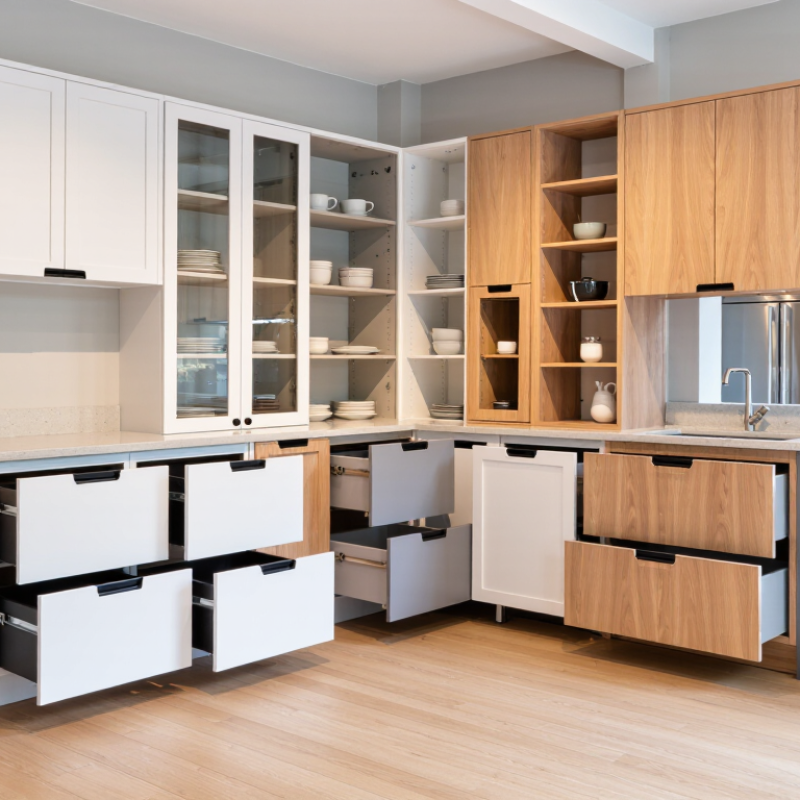
Base cabinets are the lower storage units installed directly on the floor. They support countertops, sinks, cooktops, and daily kitchen equipment. Typical units measure about 34.5 inches high before countertop installation. Their depth is commonly 24 inches, creating a practical work surface.
Wholesale buyers need base cabinets because they influence project cost, installation speed, and customer satisfaction. The Joint Center for Housing Studies reported that U.S. remodeling spending reached approximately $472 billion in 2022. That scale creates steady demand for dependable replacement components. However, low prices alone do not guarantee value. Poor hinge alignment, uneven panels, or weak drawer boxes can create expensive service problems.
Cabinet selection should match real jobsite conditions. Check moisture resistance, fastening points, finish consistency, and packaging protection. The 2024 Houzz U.S. Kitchen Trends Study found that homeowners continue investing in functional storage improvements. Deep drawers and organized cabinet interiors remain practical priorities. Buyers should still question survey trends. A popular feature may not suit every market, rental property, or installation crew.
Measure carefully. Specify clearly. Small errors become large claims.
Which Base Cabinet Types, Sizes, and Materials Are Available?
2026 Best Base Cabinets for Wholesale Buyers?
Base cabinets shape storage, workflow, and installation cost. Standard units are usually 24 inches deep and 34.5 inches high before countertops. Common widths range from 9 to 48 inches, with 3-inch increments supporting flexible layouts. Drawer bases improve access, while sink bases need plumbing clearance. Corner cabinets can recover space, but poor planning creates unreachable shelves.
Available materials include plywood boxes, particleboard panels, MDF components, and solid-wood or engineered-wood doors. Plywood handles repeated assembly well, but quality varies by thickness and edge sealing. MDF offers a smooth painted surface, though moisture exposure remains a concern. The NKBA 2024 Kitchen Trends Report highlights storage and functional planning as continuing priorities. Houzz’s 2024 U.S. Kitchen Trends Study reported a median major-remodel spend of $60,000, making durable cabinet specifications important for project control.
Tips: Compare box thickness, hinge ratings, drawer load capacity, finish warranties, and replacement-part access. Request physical samples. A catalog photo can hide uneven grain or weak edging. Leave tolerance for walls that are not perfectly square. Buyers often chase the lowest unit price, then absorb higher installation and replacement costs. That tradeoff deserves review.
How Can Buyers Assess Quality, Functionality, and Compliance?
For 2026 wholesale buyers, cabinet quality should be tested, not guessed. The 2024 Houzz U.S. Kitchen Trends Study reports that 76% of renovating homeowners upgraded their cabinets. That demand makes consistent construction essential. Inspect a sample box for square corners, tight joints, smooth drawer movement, and even edge-banding. Measure the box. Check the back panel.
Functionality deserves equal attention. The NKBA 2024 Kitchen Trends Report highlights storage efficiency and improved organization as continuing priorities. Ask whether drawers support practical loads without racking. Test hinges through repeated opening cycles. Check adjustable shelves, soft-close performance, and clearance around plumbing cutouts. A cabinet can look excellent and still waste usable space. That failure is easy to miss in a showroom.
Compliance must be documented before purchase orders are released. For U.S. projects, request evidence of TSCA Title VI composite-wood compliance, including formaldehyde emissions documentation. Ask for test reports against ANSI/KCMA A161.1 where applicable, plus production-batch traceability. Moisture-resistant materials need defined testing conditions, not vague claims. Review packaging strength, installation instructions, and warranty exclusions. I would not rely on a single flawless sample; inspect multiple units from different batches. Even careful buyers can overlook warped panels after long-distance shipping. Take photographs before acceptance. Record dimensions, defects, and corrective actions.
How Should Buyers Compare Suppliers, Pricing, MOQs, and Lead Times?
2026 Best Base Cabinets for Wholesale Buyers?
Wholesale buyers should compare suppliers through landed cost, not unit price. Include cabinet boxes, doors, hardware, packaging, freight, damage allowances, and replacement parts. A $92 cabinet can become $118 after delivery and claims. Ask for written specifications, including panel thickness, joinery, finish testing, and carton dimensions.
Demand remains substantial. The 2024 U.S. Houzz Kitchen Trends Study reported cabinet upgrades in 76% of renovated kitchens. That figure supports steady purchasing, but it does not justify accepting vague quality claims. The 2024 NKBA Kitchen Trends Report also highlights storage efficiency and durable materials as major design priorities. Request sample doors and inspect hinge alignment, drawer movement, edge finishing, and color consistency under ordinary lighting.
Pricing must be tested against MOQ and lead time. Compare three order levels, such as 20, 100, and 300 units. Record production days, sailing time, port handling, and the promised replacement schedule. Ask whether mixed colors or sizes change the MOQ. Some suppliers quote attractive prices only at full-container volume. That can leave cash trapped in slow-moving inventory. It happens.
A practical scorecard can assign 35% to quality, 25% to landed price, 20% to lead-time reliability, and 20% to service. Verify claims with recent purchase records, inspection photos, and references from comparable buyers. The U.S. Census Bureau’s 2024 construction data shows remodeling demand remains active, yet forecasts can shift quickly. Build a small trial order before scaling. Mistakes here are expensive.
Which Base Cabinets Suit Different Wholesale Projects in 2026?
2026 Best Base Cabinets for Wholesale Buyers?
Which Base Cabinets Suit Different Wholesale Projects in 2026?
Wholesale base cabinets should match project pressure, not just showroom appearance. Houzz’s 2024 U.S. Kitchen Trends Study reported that 76% of renovating homeowners upgraded cabinetry. That demand creates volume, but every project needs a different specification.
For rental apartments and build-to-rent homes, choose standard 24-inch-deep cabinets with adjustable legs and durable thermofoil or laminate fronts. Flat-panel doors simplify replacement across hundreds of units. Full-extension drawers improve daily use, while moisture-resistant panels reduce swelling near sinks. A 2025 National Kitchen & Bath Association market outlook also highlighted continued demand for practical storage and efficient layouts. Keep spare doors and hinges in stock. Small parts matter.
For hotels, student housing, and serviced apartments, prioritize fast installation. Factory-assembled boxes can reduce site labor, although shipping damage may increase. That trade-off needs testing. Use reinforced sink bases, concealed soft-close hinges, and edge-sealed panels. In coastal or humid markets, standard particleboard may perform poorly without proper sealing.
For upscale residential developments, buyers often expect deeper drawers, cleaner reveals, and custom sizes. Offer plywood construction, painted or wood-veneer fronts, and integrated waste-storage options. The 2024 Houzz study also showed strong interest in personalized storage solutions. However, premium hardware can raise replacement costs. A wholesale buyer should compare lifecycle value, not the lowest invoice. Sample testing is still essential; catalogs rarely reveal how a drawer behaves after repeated loading.